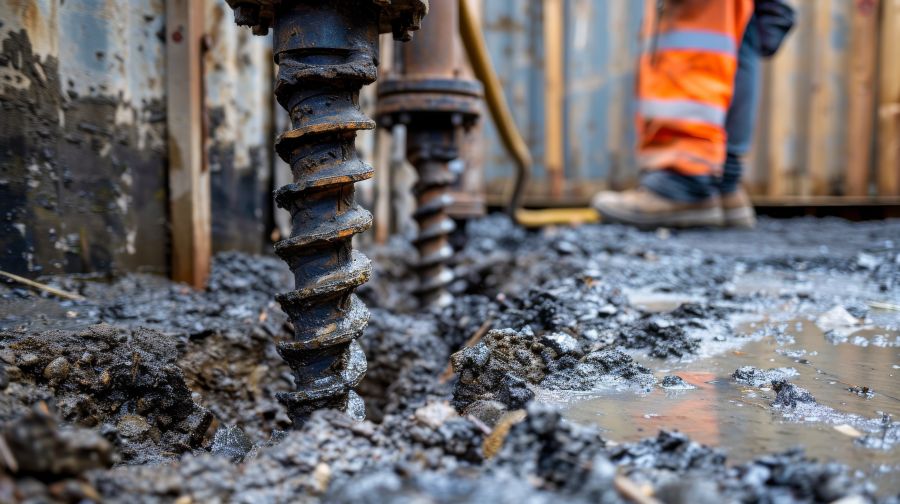
We at Park Range Construction having been installing various foundation support systems for almost half a century. One of these systems involves helical piles, but what are they? Helical piles, also known as helical piles or screw piles, are deep foundation solutions used to support structures in areas where traditional foundations might not be suitable. They are particularly effective in areas with poor soil conditions or where there is a need for deep foundation support. Understanding the advantages and disadvantages of helical piles can help you decide if they are the right choice for your structural foundation needs.
Advantages of Helical Piles
1. Quick Installation
Speed and Efficiency: Helical piles can be installed rapidly, often within a day or two, depending on the project size. The installation process is less time-consuming compared to traditional foundation methods, which can take weeks.
2. Minimal Disruption
Less Invasive: The installation of helical piles causes minimal disruption to the surrounding environment. There is no need for extensive excavation, which reduces the impact on landscaping and existing structures.
3. Versatility
Wide Range of Applications: Helical piles can be used for various applications, including new construction, foundation repair, and underpinning. They are suitable for both residential and commercial projects.
4. Load-Bearing Capacity
High Load Support: Helical piles can support substantial loads, making them ideal for heavy structures. Their design allows for even distribution of weight, providing stable and reliable support.
5. Adaptability to Soil Conditions
Effective in Poor Soils: Helical piles are particularly useful in areas with challenging soil conditions, such as clay, silt, sand, and expansive soils. They can reach deeper, more stable layers, providing a solid foundation.
6. Cost-Effective
Lower Costs: While initial costs can vary, the reduced labor, excavation, and time requirements often make helical piles a cost-effective solution compared to traditional foundation methods.
7. Immediate Load Bearing
Instant Support: Once installed, helical piles can immediately bear the weight of the structure. This eliminates the need for curing time required by concrete foundations, accelerating the construction timeline.
Disadvantages of Helical Piles
1. Limited Availability
Access to Specialists: Not all contractors are experienced with helical piles. Finding a qualified and experienced installer can be challenging, particularly in regions where this technology is not widely used.
2. Cost Variability
Initial Investment: The cost of installing helical piles can be higher than traditional foundation methods, particularly for small projects. However, this is often offset by lower labor and excavation costs.
3. Load Limitations
Structural Limitations: While helical piles are suitable for many applications, they may not be appropriate for extremely heavy structures or certain types of buildings without additional engineering support.
4. Soil Condition Requirements
Specific Soil Needs: While adaptable, helical piles are not suitable for all soil types. For instance, extremely dense or rocky soils may pose challenges during installation, requiring specialized equipment or techniques.
5. Equipment Access
Space Constraints: The installation of helical piles requires access for machinery. In confined spaces or built-up areas, maneuvering the necessary equipment can be difficult, potentially limiting their use.
Conclusion
Park Range will help you decide which system is best for your foundation. But keep in mind that helical piles offer numerous advantages for structural foundations, particularly in areas with challenging soil conditions or where quick installation is a priority. Their versatility, load-bearing capacity, and minimal environmental impact make them an attractive option for many construction projects. However, potential disadvantages such as limited availability of experienced contractors, cost variability, and specific soil requirements should be carefully considered. Consulting with a structural engineer or foundation specialist can help determine if helical piles are the right solution for your specific needs.